
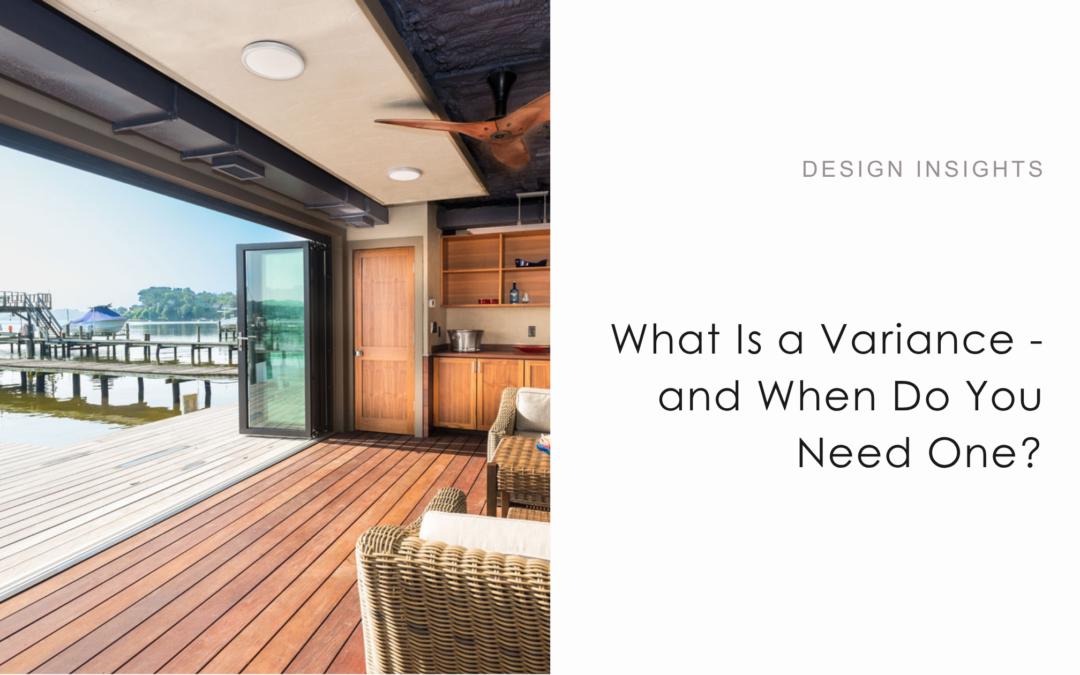
If you own property near Maryland’s waterfront, you may have heard the term “Critical Area variance” come up in conversations about renovation or new construction. A zoning variance can apply to properties both inside and outside the Critical Area, as well as an environmental variance. It sounds bureaucratic and honestly, the process can be. But understanding if, and which type of variance might be required can save you real time and money before a project gets off the ground.
We’ve been through this process many times with clients, including two successful variance approvals in just the past two months. We’ve built a clear, step-by-step approach to navigating it. Here’s what you need to know.
The Basics: What Is a Variance?
A variance is formal process to be granted permission to do something that is not allowed by law. These could be county zoning regulations, state Critical Area regulations, or environmental regulations enacted by the state or the county. In Anne Arundel County, a common trigger is encroaching on a zoning setback. Within the Critical Area (a state-designated buffer zone that extends 1,000 feet from the Mean High-Water Line) the triggers could be exceeding the limitation on lot coverage or impervious surface. Environmental regulations restrict disturbance in steep slopes, near sources of water and removal or damage to trees. The Environmental and Critical Area regulations are strict in our area due to our efforts to clean the surrounding bodies of water. Development negatively impacts the water quality of our rivers and the Chesapeake Bay by causing polluted runoff and reducing the ecosystem services that our plants and trees provide in cleaning the stormwater before it reaches the shoreline. If your proposed design pushes against any of these regulatory restrictions, you’ll need to go through a formal review and approval process before you should invest in the full design of your project.
How the Process Works
The variance process in Anne Arundel County has four main phases: pre-filing, formal application, a public hearing, and the Hearing Officer’s decision.
Before a proposed design is formally submitted, we start by assessing whether a variance would be required based on the desired goal/s of the homeowner. Sometimes a small design adjustment can eliminate the need for a variance entirely. We strive to find that path first, often informally with the collaboration of Critical Area staff in the Office of Planning and Zoning. When a variance is unavoidable, we submit a pre-file application to establish the Planning and Zoning office’s formal opinion through the staff review process. This can provide helpful early feedback before committing to the full variance application.
From there, the formal application involves preparing a detailed package that includes floor plans and elevations, before and after site plans, a letter of explanation, and many other forms such as the Critical Area Worksheet, for example. The Letter of Explanation and the Site Plan must be provided to surrounding property owners within 300 feet. A public hearing is scheduled when the Hearing Officer reviews the case with the homeowner/s, a member of our team, and any public who cares to attend the Zoom meeting. A decision of approval or denial by the Hearing Officer follows within two to four weeks. There’s a 30-day window during which a member of the public or the homeowner can appeal. Once that timeframe passes, the project moves back into our standard design and production workflow.
From pre-file to final approval, the process typically takes three to four months. It’s not fast, but with the right preparation it’s manageable and we guide clients through every step.
What This Means for Your Project Timeline
If a variance is in the picture, it needs to be accounted for early. The variance phase happens before permitting begins, which means it adds time to the front end of a project. Clients who come to us knowing they want to build near the water or other environmentally protected features, benefit from bringing us in during initial planning, before they’re set on a specific footprint, so we can design around the constraints and minimize the likelihood of needing variance approval in the first place.
One other important note: once a variance is approved, the site plan and footprint are locked in. Permit drawings must match the approved documents exactly. That’s why the pre-application phase matters so much. Changes after approval would invalidate an approved variance.
Our Approach
We’ve developed an internal process for variance work that’s thorough, efficient, and built around protecting our clients from surprises. Our goal is to file comprehensively, starting with a strong, well-documented application that gives the project the best possible shot at approval.
Have Questions About Your Property?
If you’re thinking about building or creating an addition and aren’t sure whether zoning, environmental or critical area restrictions might apply, we’re happy to take a look. An initial consultation at the start of your planning can clarify a lot and help you plan strategically from day one.
Call 443-898-9480
HD Squared Architects
79 West Street, Level 2, Annapolis, MD 21401
Mon – Fri: 8:30 am – 5 pm
Evenings/weekends by appointment.
 |  |
Woman-Owned Business
©2025 HD Squared Architects, LLC




Recent Comments