
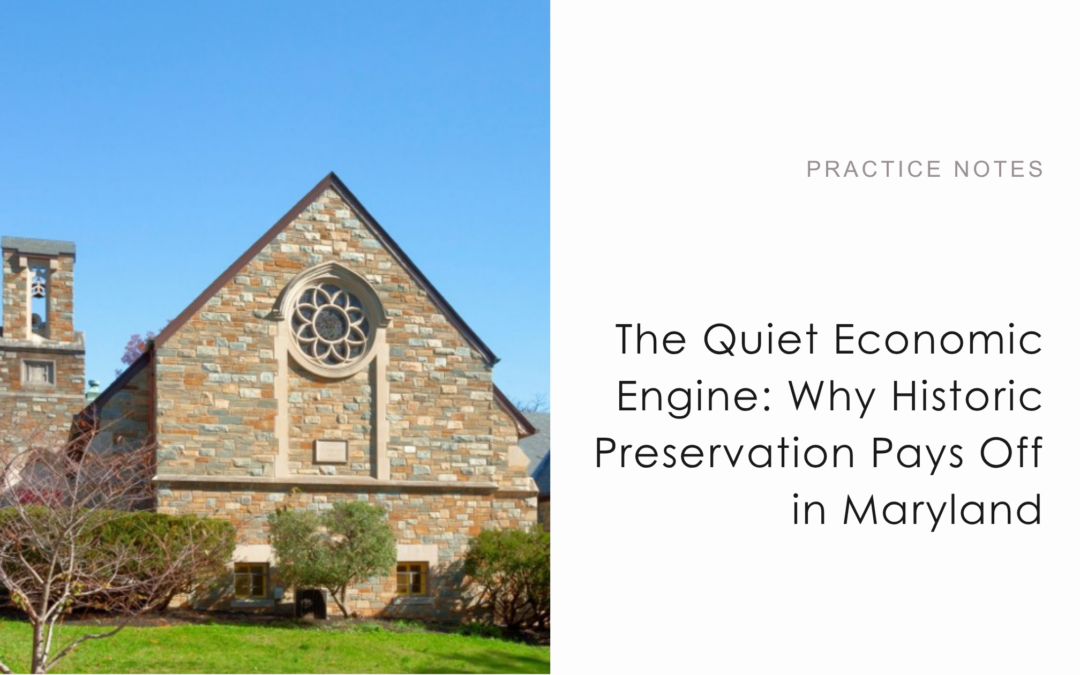
When most people think about historic preservation, they picture a beautifully restored façade or a saved building given new life. What they rarely picture is a balance sheet. And yet in Maryland, some of the strongest arguments for preserving historic buildings show up not in aesthetics, but in jobs, tax revenue, and long-term return on investment.
The economic case has been clear to those of us working in this space for a long time. The data, especially in Maryland, makes it hard to dispute.
A Tax Credit Program With a 30-Year Track Record
Maryland’s Historic Revitalization Tax Credit Program, administered by the Maryland Historical Trust since 1996, has become one of the state’s most effective community development tools. Since its creation, the program has invested more than $498 million in rehabilitation projects across the state, improving over 5,600 homeowner properties and 872 commercial historic structures.
A 2020 study by the Abell Foundation and Real Property Research Group found that every $1 of tax credits invested returns $8.13 in total economic output to the state, and that every $1 million in credits creates 49.2 jobs — 29.2 of them directly on-site during construction. The same study estimated the program has supported roughly 24,460 jobs in total through construction and the reuse of historic buildings. For a state-administered economic development program, those are hard numbers to argue with.
Heritage Areas: A $7 Return for Every $1 Spent
The tax credit is one piece of the picture. Maryland’s 13 designated Heritage Areas, including the Annapolis, London Town, and South County Heritage Area right in our backyard, form a coordinated network of historic sites, landscapes, towns, and cultural institutions. A 2021 economic impact study by Parker Philips Inc. found that in 2019 alone, these areas generated more than $2.4 billion in economic impact, welcomed 22.6 million visitors, supported over 33,800 jobs, and produced nearly $320 million in state and local tax revenue.
The state’s annual investment in the program is capped at $6 million. The return is roughly $7 in tax revenue for every $1 spent. By any measure, that is a strong performing public investment.
The Infrastructure Math That Often Gets Overlooked
Beyond tax credits and tourism, there’s a quieter argument for rehabilitation that rarely gets enough attention. A 2009 Maryland study by Joseph Cronyn and Evans Paull, published through the Abell Foundation, compared the rehabilitation of a 50,000-square-foot historic industrial building to constructing a new building of the same size on the urban edge. Rehabilitation produced infrastructure savings of $500,000 to $800,000 per project — water, sewer, road, and utility extensions that simply didn’t need to be built because the existing site already had them.
That savings compounds when you consider that historic buildings tend to be located in walkable, already-served neighborhoods. The infrastructure investment has already been made. Rehabilitation puts it to work.
What This Looks Like on the Ground
The numbers are useful, but they land differently when you see them play out at the project level. A vacant historic storefront becomes a renovated mixed-use building with apartments above and a local business below. Property values stabilize. A homeowner uses the residential tax credit to repair a slate roof or restore original windows, and local tradespeople get the work. A heritage destination draws visitors who stay overnight, eat locally, and spend at local shops — revenue that funds the next round of preservation.
This is the part that rarely makes it into the reports but matters most: preservation reinforces the kinds of places people actually want to live in, work in, and visit.
What It Means for Our Practice
Our team has seen these dynamics across project types — from main-street storefronts to institutional buildings to rural sites with deep community roots. The data backs up something we already believed: that working thoughtfully with what’s already there is rarely the more expensive path. More often, it’s the smarter one.
Maryland’s incentive landscape is genuinely favorable for anyone considering a historic property, whether to acquire, rehabilitate, or reposition one. The tax credit program has commercial, small commercial, and homeowner pathways, each with different thresholds and benefits. Understanding those options early can meaningfully shape what a project looks like — and what it costs. Collaborating with critical partners such as Preservation Maryland truly drives the project to success.
If you’re weighing a historic project and want to talk through what’s possible, we’re happy to have that conversation.
Call 443-898-9480
HD Squared Architects
79 West Street, Level 2, Annapolis, MD 21401
Mon – Fri: 8:30 am – 5 pm
Evenings/weekends by appointment.
 |  |
Woman-Owned Business
©2025 HD Squared Architects, LLC




Recent Comments